
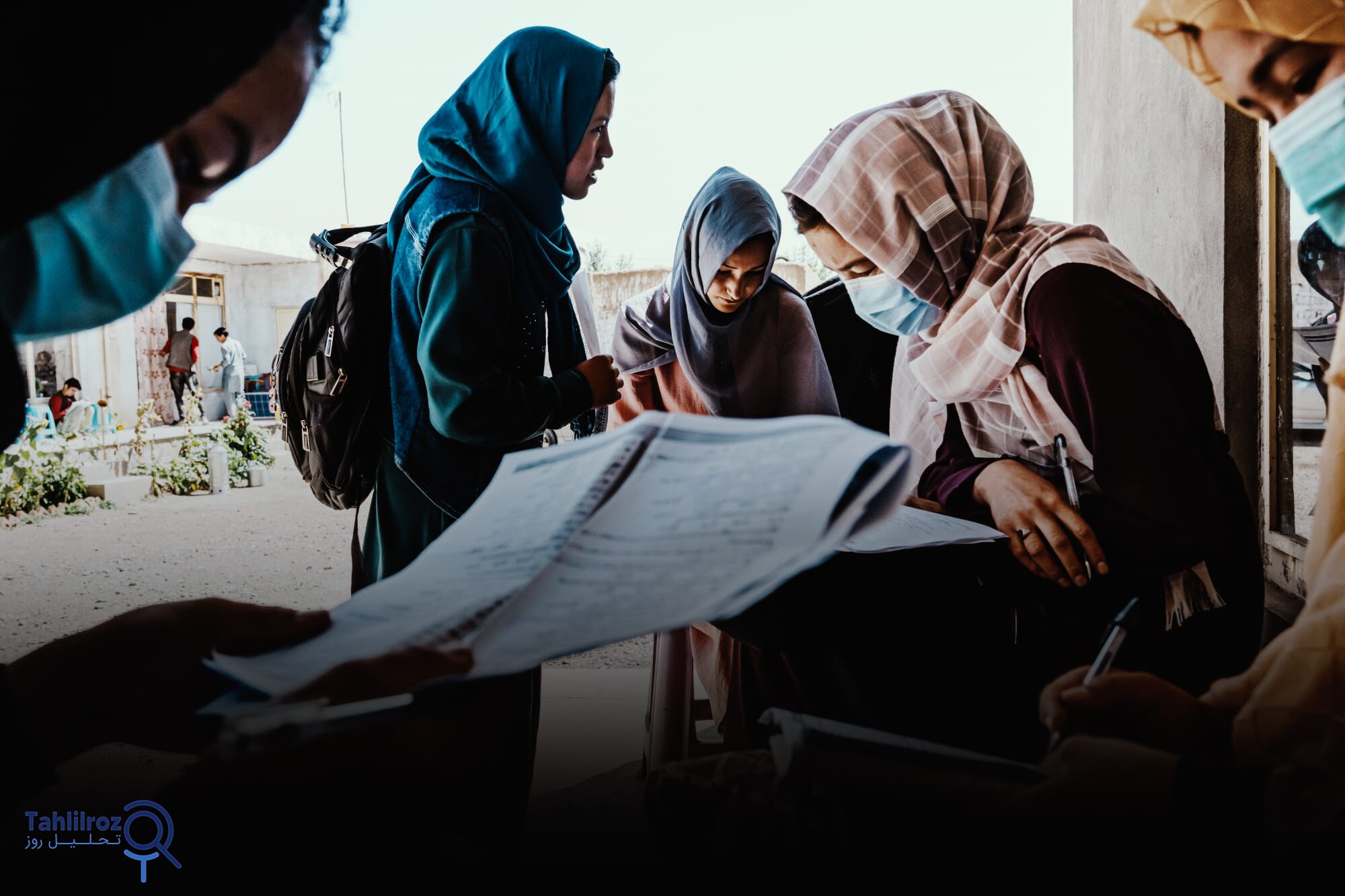
Nargis is a pseudonym used to protect the identity of the young woman whose story inspired this narrative.
Before the doors of her school were closed, Nargis measured time in lessons.
She counted the days until examinations, the months until graduation, and the years until she could wear a white coat and introduce herself as a doctor. She lived in a modest neighbourhood of Kabul, in a house where every afghani was carefully spent and every dream had to survive against the pressure of daily life.
Her father was elderly and had lost one of his legs during the war. He ran a small shop at the end of their street, selling tea, biscuits, soap and other household items. The income was barely enough to cover the family’s basic needs. Nargis’s older sister worked as a teacher, and her salary helped pay for food, medicine and electricity.
Nargis understood poverty from an early age. She saw people entering clinics and leaving without medicine because they could not afford it. She saw mothers waiting outside pharmacies, counting coins in their hands. She often told her family that when she became a doctor, she would reserve one day each week for poor patients.
“I will not charge them,” she would say. “And when I can, I will buy their medicine too.”
Her uncle had begun calling her “Doctor Nargis” when she was still in the tenth grade. Every time he used the title, she smiled widely, as though the future had already arrived.
She was one of the strongest students in her school. Her notebooks were neat, her handwriting careful, and her textbooks filled with notes. When schools closed during the COVID-19 pandemic, Nargis did not stop studying. She borrowed twelfth-grade books even though she had not yet completed the eleventh grade. At night, while the rest of the family slept, she studied beneath the weak light of a lamp.
Her mother sometimes entered the room after midnight and found her leaning over a mathematics problem or memorising a biology lesson.
“You still have time before the university entrance examination,” her mother would say. “Do not make yourself ill.”
But Nargis would shake her head.
“I don’t want an ordinary result. I want the highest score.”
Her sister understood that this was not simply ambition. For Nargis, education was a promise: a promise that poverty would not define her, that being born a girl would not limit her, and that one day she could serve the people whose suffering disturbed her so deeply.
Then, in August 2021, the Taliban returned to power.
At first, like many families, Nargis’s relatives did not understand how completely life would change. There were rumours, contradictory announcements and repeated promises that girls’ education would continue within an “Islamic framework.” Nargis held onto every public statement suggesting that secondary schools would reopen.
She washed and ironed her old uniform. She arranged her books inside her schoolbag and placed it beside her bed. Each evening, she checked her pens and notebooks, as though being prepared might somehow help the doors open sooner.
When the new school year approached, her hope returned with unusual force.
On the morning she believed classes would resume, Nargis woke before everyone else. She dressed in her old uniform, combed her hair and carefully placed her scarf over her head. Her mother later remembered that her face looked brighter than it had in months.
Her large dark eyes shone with excitement.
She left home with a friend, walking quickly toward the school.
Less than an hour later, she returned.
Her mother heard the gate open and expected to see her daughter laughing. Instead, Nargis entered the courtyard in tears. Her face had lost all colour, and her eyes were swollen.
“What happened?” her mother asked.
Nargis struggled to speak.
“It is over,” she finally said. “There is no school. There are no lessons. There is no future.”
The authorities had again prevented teenage girls from entering their classrooms.
Her mother embraced her and tried to offer reassurance.
“God is merciful,” she said. “Perhaps it is only for a few days. Schools will open again.”
Her sister remained silent. As a teacher at a girls’ school, she understood what the closure might mean—not only for Nargis, but for millions of girls and for women like herself whose employment depended on girls being allowed to study.
In the days that followed, Nargis kept her schoolbag near the door.
At first, she continued studying at home. She reviewed her textbooks and followed whatever informal lessons she could find. She told herself that the ban could not last. The world would object. Muslim scholars would speak out. Afghan families would demand that their daughters return to class.
Weeks passed.
Then months.
The schoolbag remained untouched.
The books accumulated dust.
Nargis gradually stopped studying. She no longer stood in front of the mirror holding thick books against her chest, pretending they were medical textbooks. She stopped talking about university and no longer smiled when relatives called her “Doctor Nargis.”
Her family noticed the change slowly. At first, they thought she was simply disappointed. Then she began withdrawing from everyone around her.
She stopped joining family conversations. When friends visited, she offered short answers and returned to her room. She no longer helped with household work. Some days, she barely ate.
Her laughter disappeared.
Her mother tried to comfort her with stories of difficult times that had eventually passed. Her father reminded her that she was not alone—that millions of Afghan girls were also waiting.
But this offered Nargis little comfort.
“That does not make it easier,” she told him. “It makes it worse.”
Her sister searched for online courses and copied learning materials onto her phone. Yet electricity was unreliable, internet access was expensive, and studying through a small screen did not replace the classroom Nargis loved.
She missed the sound of her classmates. She missed writing on the blackboard, competing for the highest marks and arguing over difficult questions. She even missed the crowded hallways and the early-morning walk to school.
Most of all, she missed the version of herself who had believed the future was open.
As the closures continued, Nargis developed severe depression. She slept at irregular hours and suffered from periods of anxiety. Her family took her to a mental-health professional, who prescribed medication. When the first treatment did not help, they consulted another doctor.
Her mother began watching her closely.
For a time, Nargis appeared to improve. She started eating with the family again and occasionally spoke about ordinary things. Her parents treated every small sign of recovery as proof that their daughter was returning to them.
But the grief remained beneath the surface.
One spring morning, almost three years after she had been excluded from school, Nargis woke with an unusual calmness. She sat with her family and ate breakfast. Her mother noticed that she seemed lighter, almost peaceful.
Later, Nargis told her sister that she wanted to visit their old school.
Her sister hesitated.
“You know the secondary section is closed,” she said.
“I know,” Nargis replied. “I only want to see my classroom. I want to sit in my chair once.”
They walked together through streets Nargis remembered from her school days. Along the way, she spoke about former classmates, teachers and harmless jokes from lessons. Her sister felt hopeful. For the first time in months, Nargis was speaking with energy.
When they reached the school, the courtyard was silent.
A cleaner sitting near the entrance recognised Nargis immediately. Most staff had known her because she had consistently ranked first in her class.
“Doctor Nargis,” the woman said gently. “You came back.”
Nargis smiled faintly.
“I missed the school,” she answered. “Especially our classroom.”
The cleaner allowed her to enter.
Nargis walked slowly through the empty corridor. The silence made the building feel abandoned, almost unreal. She passed doors behind which lessons had once taken place and stopped outside her classroom.
Inside, the desks remained arranged in rows.
Dust covered the blackboard.
For several minutes, Nargis sat in her old chair. She looked toward the front of the room and imagined her teacher standing there. She could almost hear pages turning and students whispering.
Then she stood and approached the blackboard.
She wiped away the dust with her sleeve and asked the cleaner for a piece of chalk.
Her hand trembled as she wrote:
You ended everything for us.
She placed the chalk down and left.
Her sister had already gone to the nearby primary school where she still taught younger girls. Nargis returned home alone.
Her mother was preparing lunch when she entered.
“Why is your face so pale?” she asked.
“Everything is finished,” Nargis replied.
Her mother tried to distract her.
“I cooked your favourite beans. Rest now, and we will eat when your father and sister return.”
Nargis said she was tired and went to her room.
A few hours later, her sister came home. The family prepared lunch and asked her to wake Nargis.
When she entered the room, she knew immediately that something was wrong.
Nargis did not respond.
The family rushed her to hospital, but the doctors could not save her.
Later, in her room, her sister found a letter.
Nargis had asked her parents to forgive her. She wrote that the return of spring had reminded her of the morning when she had dressed for school, only to discover that the doors remained closed. She apologised for being unable to serve her family, her country or the poor patients she had once hoped to treat.
At the end of the letter, she made one final request:
Write on my grave: Nargis, the girl who died longing for education.
Her death shattered the family.
Her mother repeated the childhood title through tears: “My doctor. My young doctor.”
Her father closed his shop for many days. He sat silently in the courtyard, staring at the schoolbag that still rested near the wall.
Her sister could no longer enter a classroom without seeing Nargis seated in the first row.
The family buried her with the books she had treasured nearby, but they could not bury the questions her death left behind.
What happens to a society when education becomes forbidden to half its population?
What becomes of girls who are repeatedly told to wait, while their most important years disappear?
How many future doctors, teachers, writers, engineers and scientists have been forced into silence?
Nargis’s story is not only about one young woman. It reflects the suffering of countless Afghan girls whose ambitions were interrupted after the Taliban returned to power.
Some continue to study secretly.
Some have found online courses or informal schools.
Some have left Afghanistan.
Some remain at home, watching their brothers attend classes and universities while their own books gather dust.
Many still keep their school uniforms folded inside cupboards, unable to throw them away.
The tragedy of Nargis is not that she lacked talent, discipline or determination. She had all three.
Her tragedy was that the political system around her treated her dreams as a threat.
She wanted to become a doctor. She wanted to heal people, especially those who were poor. She wanted to study, work and contribute to her country. These were not dangerous ambitions. They were ordinary hopes shared by young people everywhere.
Yet for Nargis, they became impossible.
After her death, her sister returned once more to the abandoned classroom. The words Nargis had written were still visible on the blackboard.
You ended everything for us.
Her sister took a cloth and raised it toward the board, but she could not erase the sentence.
Instead, beneath it, she wrote another line:
Not everything. Your story remains.
She left the words there—not as an answer, but as a promise.
Nargis would never attend university. She would never wear the white coat she had imagined or open the clinic she had described to her family. She would never offer free treatment to those who could not afford it.
But her story could still speak.
It could remind the world that denying girls an education is not an abstract policy. It enters homes. It reshapes families. It destroys confidence, health and hope. It takes young women who once planned their lives in years and teaches them to see only closed doors.
Nargis’s schoolbag remained ready until the end.
Inside it were notebooks, pens, a ruler and the biology book she had planned to review before the university entrance examination.
On the first page, in her careful handwriting, she had written a sentence:
One day, I will become a doctor.
That day never came.
But somewhere in Afghanistan, another girl is still writing the same sentence.
And she is waiting for the doors to open.